
September Perspective
Enjoy the September 2026 Perspective journal. The Perspective is the monthly journal of Mount Vernon. It includes an article, book recommendations, and more.

September 1, 2026 • Dustin Butts
“The simple fact is that the Bible is not a book fit for children, neither in its unsavory parts—murders, rapes, genocides, betrayals, mauling by wild animals, curses, divine retribution and apocalyptic horrors—nor in many of its neutral or even uplifting parts, including statutes and ordinances, proverbs, genealogies, geographies, prophecies, censuses and pretty much all of the epistles.”1
Those words were penned by Sarah Hinlicky Wilson in a 2013 article for the Christian Century entitled “R-rated: How to Read the Bible with Children.” I wonder if you agree with her sentiment? Should the Bible be rated R, or at least TV-MA? Is it a book fit for kids?
I think at least some Christians do believe a good bit of the Bible isn’t for children. It’s why so many children’s story Bibles blitz through the books of the Old Testament and often leave out many of the important details of the stories they do include. A prime example of this is the story of the flood in Genesis 6–9, which is often depicted as a joyful scene with lots of happy animals entering the ark while a smiling Noah looks on. God’s judgment is never mentioned. It’s also why many story Bibles end with the resurrection or a couple of “feel-good” stories from Acts, but don’t go on to mention the persecution that followed or the problems in the early church that the New Testament epistles were written to address.
These “Bibles” labor to tell the story of the Bible without any of the “unsavory parts” and, often, with very few of the “uplifting parts.” As author Rabekah Henderson explains, “Too many choose moralism over the gospel, standalone heroes’ tales over richly connected narratives, and inaccuracy over truth and care for the original text. The story of God’s love and mercy through the millennia becomes little more than a Christianese-filled Aesop’s Fables.”2
The existence of these “Bibles” and the fact that they continue to sell in large numbers is proof positive that some publishers, and likely some, if not many Christians, are convinced the Bible isn’t for children.
I’m convinced they’re wrong. And my guess is that, if you are a member of Mount Vernon, you agree with me.
So why write an article answering the question, “Is the Bible for kids?” Two reasons. First, if challenged on it, I think most of us would struggle to make a robust biblical case for why we believe the Bible is a book for children. I want to equip you to make that case.
Second, I’m convinced that even those of us who can make the case that the Bible is for children struggle to know exactly how to live in light of it. Should we be reading the ESV to our infants? Are all story Bibles bad? When should we let our children read the Bible on their own? What do we do when they come across the “unsavory” parts of the Bible? I hope to provide some practical answers to these questions.
Before we jump in, let me encourage you to resist the temptation to skip ahead to the second part of the article. As with everything in the Christian life, before we get practical, we need to start with the biblical. The Bible’s “why” must always guide and determine the “how” of Christian living. Often, the Bible’s “why” contains more “how” than we think.
How do we make the case from the Bible that the whole Bible—the “unsavory parts,” the “uplifting parts,” and everything in between—is for children? Let’s start where the Bible starts: In the beginning…
From the very beginning, mankind needed God’s words to make sense of themselves and their world and to live for his glory. When God placed Adam and Eve in the garden, he didn’t just leave them to themselves to figure out who they were or what they were to do. He blessed them and instructed them, saying, “Be fruitful and multiply and fill the earth and subdue it, and have dominion over the fish of the sea and over the birds of the heavens and over every living thing that moves on the earth” (Gen. 1:28).
Adam and Eve also needed God’s words to guard them from danger (Gen. 2:16). Though they were completely innocent, not yet knowing good and evil, they still needed to understand the importance of obeying and trusting God. They needed to learn about the nature of sin and the reality of God’s judgment. They needed to grasp the penalty for disobedience. Even in their innocence, they needed to know about death and understand that it was God’s punishment for sin.
Human beings were made to be “revelation receivers.”3 From the moment they were created, before they ever fell into sin, Adam and Eve needed God’s words. Without them, they would have been lost. The same is true for every child.
Children need God’s words to tell them who he is and what he is like. They need those words to explain who they are and what God created them to be and do. They need God’s words to understand what is wrong with the world, and what’s wrong with them. They need his words to teach them what sin is and what it deserves. Even in their childhood “innocence,” children need God’s words.
Fast forward to the Exodus. When he instituted the Passover, God called his people to tell the story to their children year after year. He gave them words, his words, to share with their little ones. God said, “You shall say, ‘It is the sacrifice of the LORD’s Passover, for he passed over the houses of the people of Israel in Egypt, when he struck the Egyptians, but spared our houses’” (Exod. 12:27). God wanted the Israelite children to know of the great salvation and the great devastation brought about by his mighty hand.
But it wasn’t just the story of the Exodus that God wanted Israel’s children to hear. He also wanted them to hear his law. Every word of it. From laws about bodily discharges to laws about sacrifices (Lev. 15–17). From laws about unlawful sexual relations to the command to love your neighbor as yourself (Lev. 18–19). Parents were to diligently teach all these words of the Lord to their children (Deut. 6:6–7).4 And, every seven years, they were to bring their little ones with them to the Feast of Booths where the law would be read “before allIsrael in their hearing. . . that they may hear and learn to fear the LORD your God, and be careful to do all the words of this law” (Deut. 31:11–12).
Israel’s children weren’t given a pass on knowing and obeying all the words of God’s law. They were expected to hear those words and to learn from them to fear Israel’s God. And parents were primarily tasked with ensuring that their little ones heard and understood everything that God said to his people.
Clearly, the children in Israel were expected to know everything God said and did from Genesis to Deuteronomy. But what about the other works and words of God recorded in the Old Testament? Did they need to be protected from the awful scenes recorded in Judges or the callousness of Eli and the wickedness of his sons in the book of Samuel? That doesn’t appear to be the case.
In Psalm 78, the psalmist leads the congregation of God’s people to proclaim: “We will not hide them from our children, but tell to the coming generation the glorious deeds of the LORD, and his might, and the wonders that he has done” (Ps. 78:4). He then goes on to recount several of these glorious deeds. They include the miracles of the Exodus and God’s works of mercy and judgment in the wilderness. But they also include his judgments against Israel in the time of the judges, which ultimately culminated in the capture of the ark and the death of Eli and his sons (Ps. 78:57, 60–64).
None of these events were to be hidden from Israel’s children. They were to be told to the coming generation, “that they should set their hope in God . . . and not be like their fathers” (Ps. 78:7, 8). God’s works and words were for the Israelites and their children.
In the fullness of time, God’s Word became flesh and dwelt among us (John 1:1–18). Jesus spoke the words of God to all who would hear (John 12:49–50; 15:15; 17:8, 14). And, throughout his ministry, he spoke to crowds that consistently contained children (e.g., Matt. 14:21; 15:38; John 6:9).
One particularly striking account of a child hearing Jesus speak the words of God is found in Matthew 18. His disciples asked him, “Who is the greatest in the kingdom of heaven?” And, in response, Jesus called a child to himself and placed the child in the midst of them. With the child listening on, Jesus proceeded to speak not only of the humility needed to enter the kingdom, but of God’s judgment for leading others to sin and the fact that it is better to cut off your hand if it causes you to sin than to be thrown into the eternal fire (Matt. 18:5–9). Apparently, he didn’t think the child needed to be shielded from these sayings. When the Word spoke God’s words—even the “harder” ones—he spoke them to adults and children.
The early church was also convinced that God’s words were for children. Children gathered with their parents to hear the words of God read and preached each Lord’s day. We know this because Paul directly addressed children in his letters to the churches in Ephesus and Colossae (Eph. 6:1–3; Col. 3:20).
Paul, James, Peter, and John knew that, when received, their letters were read aloud to everyone in the gathering. This means that when Paul wrote 1 Corinthians, which addresses the “adult” topics of adultery, prostitution, and sexual relations in marriage, he knew children would be in the room listening to every word he penned. Similarly, when Peter wrote of the debauchery of unbelievers, the fiery trials of persecution that would come upon the church, and the coming day when the heavens would be set on fire, he was aware that he wasn’t just writing to adults. As the apostles wrote God’s words to the churches, they knew they were writing not only to the churches but also to the churches’ children.
One passage sums up this survey of Scripture’s take on whether or not the whole Bible is for children. It’s the familiar passage found in Paul’s second letter to Timothy. There, Paul encourages Timothy to persevere in the faith with these words:
But as for you, continue in what you have learned and have firmly believed, knowing from whom you learned it and how from childhood you have been acquainted with the sacred writings, which are able to make you wise for salvation through faith in Christ Jesus. All Scripture is breathed out by God and profitable for teaching, for reproof, for correction, and for training in righteousness, that the man of God may be competent, equipped for every good work. (2 Tim. 3:14–17)
The sacred writings Paul speaks of were not a select portion of the Scriptures. He’s not just talking about the “kid-friendly” parts. Timothy’s mother and grandmother acquainted him with all of God’s words because, like Paul, they believed all of those words were good for Timothy’s soul. They were convinced God’s words were able to make him wise for salvation. Why? Because all of Scripture—the “unsavory” and the “uplifting” parts—points to the person and work of Jesus Christ. All of it leads us to his cross and resurrection—the most unsavory and uplifting moments in all of human history. When we limit the parts of the Bible our children are exposed to, we ultimately limit their view of Christ.
Paul’s admonition to Timothy was not a call to start reading the Bible for himself, now that he was an adult. It was a call to continue unearthing the riches of the God-breathed words he was already well acquainted with.
Timothy didn’t need one set of God’s words to become wise for salvation as a child and another to grow and mature in the faith as an adult. He needed the same words. He needed all the words of Scripture.
As we survey the Bible, it’s not hard to see that Sarah Hinlicky Wilson’s assessment doesn’t match Scripture’s assessment of itself. From Genesis to Revelation, the Bible tells us that it actually is a book fit for children. The whole Bible is for kids—every word of it.
But does that mean we need to start teaching every word of it to our children right now, no matter what their age?
Yes and no. Let me explain.
Given the way she opens her article, you might expect Sarah Hinlicky Wilson to be entirely opposed to exposing children to Scripture. But she isn’t. Or, at least, you think she’d push parents to use only the most “sanitized” children’s Bibles. But she doesn’t. Immediately after saying, “the Bible is not a book fit for children,” she goes on to say this: “Scripture is definitely something to ease the little ones into, not drop them in cold.”5 On that point, we agree.
Just because the Bible is a book fit for children, that doesn’t mean we need to start reading the book of Judges to our toddlers before bedtime. There is a way to expose children to the breadth of the Bible from the earliest ages while gradually exposing them to its depths as they grow and mature.
But what should this look like? How can we faithfully expose our children to the full breadth of the Bible while easing them into its depths? To answer that question, it’s helpful to compare the Bible with a large swimming pool with a deep end. Most parents don’t teach their children to swim by throwing them into the deep end. Instead, they follow a process. First, they hold their child in their arms and wade around the swimming pool. The goal is simply to get them used to being in water.
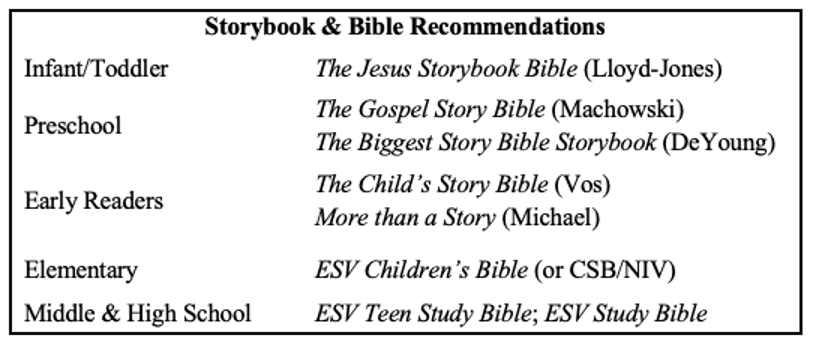
Getting a child used to being in the water of God’s word looks like a mom and dad regularly snuggling up with their infant, reading stories from a faithful children’s Bible.6 The first story Bible we read to our children was The Jesus Storybook Bible by Sally Lloyd-Jones. It does a wonderful job of simply and beautifully telling the big story of the Bible and showing how it all points to Jesus Christ. Does it cover every story that it could? No. But it does a great job of familiarizing them with the storyline and the main characters.
When our children got used to being in the pool with us, we bought them “puddle jumpers”—flotation vests that enabled them to move all over the surface of the pool while keeping their heads above the water. We jokingly called them their “beach muscles.” With their beach muscles on, they were free to wade into the deep end of the pool without going deep into the pool.
The best story Bibles for older preschoolers are those that work like “puddle jumpers.” They provide children an opportunity to experience the whole of the Bible—even the “deep end”—while keeping their heads above the water. My favorite of these is The Gospel Story Bible by Marty Machowski.7 It is quite comprehensive, with 156 stories that run from Genesis to Revelation. Machowski doesn’t shy away from the “unsavory” parts, like the story of Sodom and Gomorrah, but he also doesn’t dive too deep into them. For example, in describing the sin of Sodom, he simply says, “the city was a very wicked place.”8 Machowski also includes portions of the New Testament epistles, some of those “uplifting parts” of Scripture that most story Bibles leave out. We used The Gospel Story Bible during our family worship times for several years.
As our children grew, we began exposing them to the depth of the pool. We first taught them to put their head under the water, then taught them to swim in the shallow end. Eventually, we gave them the freedom to swim in the deep end all by themselves. And when they were comfortable there, we taught them how to dive all the way to the bottom.
Mount Vernon welcomes children of all ages into our corporate worship services, but we also offer childcare for preschoolers. Once a child enters kindergarten, they join us for corporate worship.9 This is a bit like putting their head under water when it comes to exposure to the Bible.
This year, for example, we welcomed a new crop of kindergarteners into our services in the middle of a sermon series on Revelation. The very first sermon they got to hear was on Revelation 19:1–10, where the great multitude of the redeemed rejoice and praise God, “for he has judged the great prostitute who corrupted the earth with her immorality and has avenged on her the blood of his servants” (v. 2). Quite an initiation to corporate worship!
Now, what do you do as a parent when your sweet, “innocent” kindergartener leans over mid-sermon and says, “Dad, what’s a pros-ti-dude?” Should you explain it at an adult level? Of course not. You wouldn’t shove your child’s head further under the water when you are just teaching her to dip her face in. Instead, you keep it right at the surface level. So when a little one asks about an adult topic that comes up in a sermon, you should answer truthfully, but not fully. “A pros-ti-tute is someone who uses their body in ways that don’t glorify God.” Most kindergarteners will hear that explanation, say, “Ok,” and turn back to coloring on their children’s bulletin. If they ask more questions, you can simply say, “That’s all you need to know about it right now. I’ll explain more when you are a little older. Let’s keep listening to the pastor and see what else he has to say.” An inch below the surface is sufficient.
When a child learns to read, it’s time to move into the next phase of exposure to God’s Word. This is the equivalent of teaching them to swim in the shallow end. We gave our young readers access to the various story Bibles we had at home (namely, those I mentioned above) and encouraged them to take up and read. As their reading proficiency increased, we introduced them to The Child’s Story Bible by Catherine F. Vos. We used it for family worship10—reading and discussing it with our children—and also encouraged them to read it for themselves. Vos is a master storyteller. I think I enjoyed reading The Child’s Story Bible as much as my kids.
Another wonderful story Bible for children this age is the two-volume More than a Story by Sally Michael. It’s quite comprehensive, doctrinally rich, and works hard to use child-appropriate language while at the same time soberly and seriously portraying the problem of sin.11 It also contains a helpful introductory note for parents that gives practical guidance on not just reading the Bible to your children, but reading it with them.
Swimming in the deep end of the pool all by themselves for the first time was a big deal for our children. So was getting their first “real” Bible. Around 1st or 2nd grade, when they were strong enough readers, we bought each of our children an ESV Children’s Bible and began reading it together in our family worship times. It contains the full text of the English Standard Version with illustrations of various stories sprinkled throughout. One of the things I love about it is the dictionary in the back. It helpfully and simply defines big theological words like propitiation and atonement. The dictionary also contains age-appropriate definitions for a very limited number of “adult” words, like adultery and concubine.[12] Having a resource like this in the back of their Bible encourages children to study the Word for themselves, but also to come to mom and dad for more thorough explanations of what they are reading.
Though it’s written at roughly a 10th-grade reading level, we chose to give our children the ESV Children’s Bible because the ESV is the Bible we use in our corporate worship services at Mount Vernon. Some parents may prefer something a little easier to read and understand. If so, the NIV and CSB, both written at a 7th-grade reading level, offer children’s Bibles with a similar format to the ESV Children’s Bible.
When a child can swim in the deep end on their own, it usually doesn’t take long before we teach them how to dive all the way to the bottom. But when it comes to diving deep into the depths of God’s Word, it takes a little more time.
We encouraged our children to read their ESV Children’s Bibles and gladly answered their Bible questions in age-appropriate ways throughout their elementary years. When they hit middle school, we decided it was time to start teaching them to dive deeper. We swapped out their ESV Children’s Bible for an ESV Teen Study Bibleand also got them the more robust ESV Study Bible to use for their Bible classes at school. Both contain robust study notes and articles on a variety of topics. For example, the articles in the ESV Teen Study Bibleinclude: “Online Life and the Importance of the Church,” “Identity,” and “Sexual Purity.” While you could let your preteen or teen discover and read these articles, a better option would be to point them out and find times to read and discuss together.
Parents will differ on when it is appropriate to let their children start diving into the deep end of God’s Word. My counsel: You probably need to do it a little sooner than you want to. As our children read God’s Word for themselves, they will go looking for the answers to their questions. The question parents need to answer is, where do we want them going to find their answers? Personally, I’d rather my children dive in the deep end with me and other trusted adults sitting around the pool.
That brings me to the final and most important piece of advice I want to offer parents seeking to expose their children to the full breadth and depth of God’s word. However you go about easing them into it, never leave the side of the pool. Yes, the Bible is a book fit for children, but God never meant for them to dive into it alone. He tasks parents with teaching and explaining his Word to their children (Deut. 6:4–7, 20–25; Eph. 6:4).
As they grow, we should continually be reading the Bible to our children and with our children. We don’t just teach them to swim in the deep end and dive to the bottom and then leave them to fend for themselves. Instead, God calls us to stay by the poolside, ready to swim alongside them and even to dive down to the bottom with them whenever they need us. More than that, he expects us to be people who love being in the pool ourselves, eagerly exploring its contours and depths and regularly inviting our children to come with us to see the wonderful, glorious things we’ve found.
The Bible truly is a book for all ages. May God give our children and us a wholehearted love for the whole of his Word. May he give us wisdom and grace as we seek to expose our children to its breadth and ease them into its depths. And may he use every part of it—the “unsavory” and the “uplifting”—to make our children wise for salvation through faith in Jesus Christ.
Enjoy the September 2026 Perspective journal. The Perspective is the monthly journal of Mount Vernon. It includes an article, book recommendations, and more.
Enjoy the August 2026 Perspective journal. The Perspective is the monthly journal of Mount Vernon. It includes an article, book recommendations, and more.
This article was written as part of the August 2026 Perspective Journal. Bad Students The Sadducees were the theological modernists of Jesus’ day. They only received the Torah (or Law) …